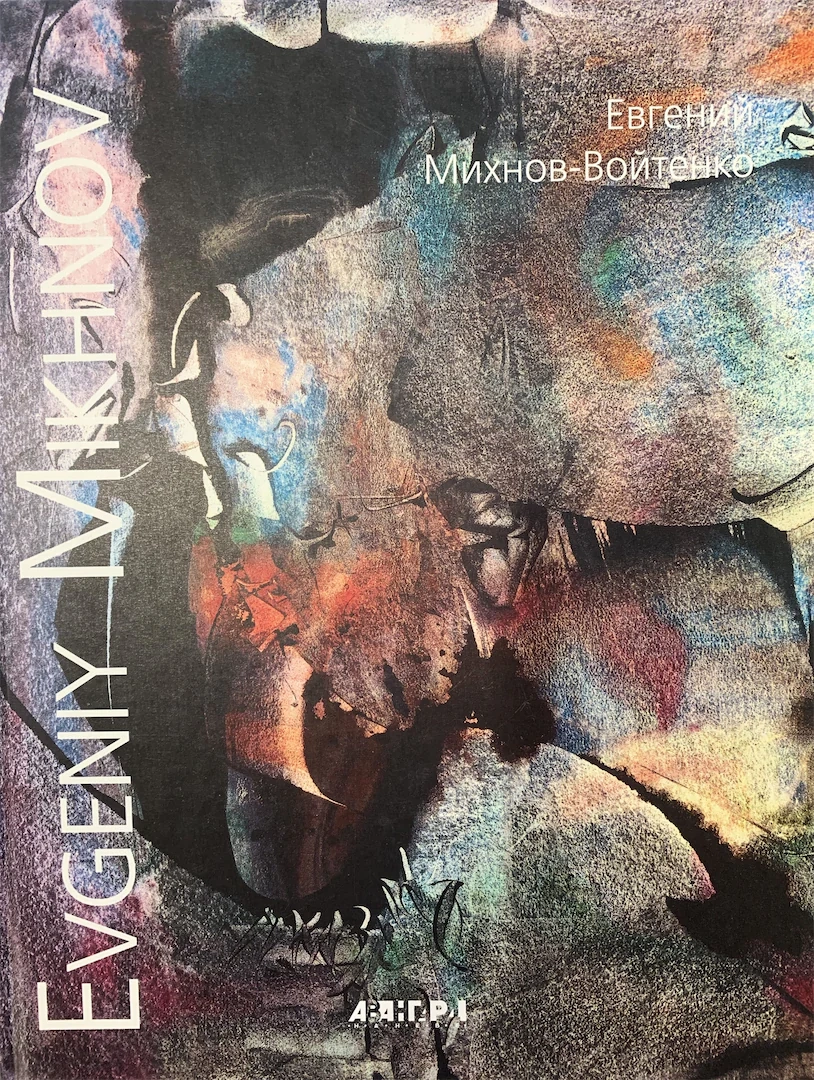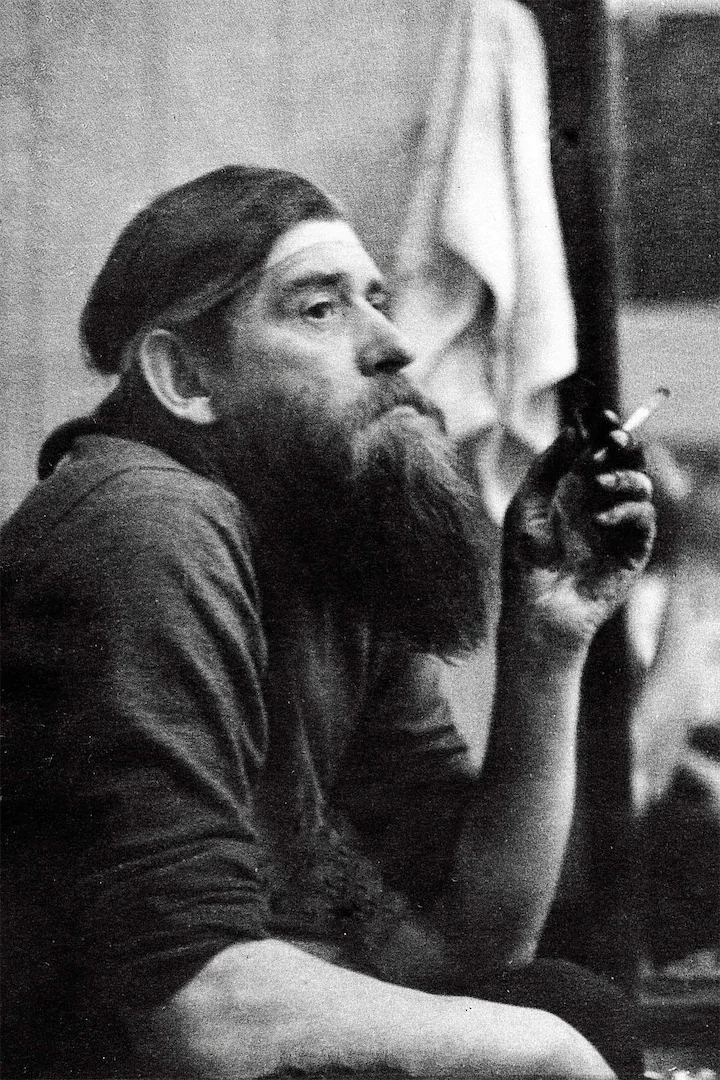
And the text was supplemented with rare archival photographs from the life of the author and the Leningrad artistic underground of the 1960s-1980s.
Shortly before the exhibition, the artist died of cancer, and the works were purchased by a Finnish gallery owner and remained hidden in a private collection for 34 years. For a long time, it was believed that the works had been stolen or lost forever, just like many others that ended up in private collections. Michnov himself always said: "Everything comes years later." And fortunately, this turned out to be true.
Fate brought us together with this mysterious person, so this year at Cosmoscow we have the honor of showing the author's new works to the public and researchers. And very soon we are preparing a retrospective exhibition project by Evgeny Mikhnov-Voytenko at DiDi Gallery.
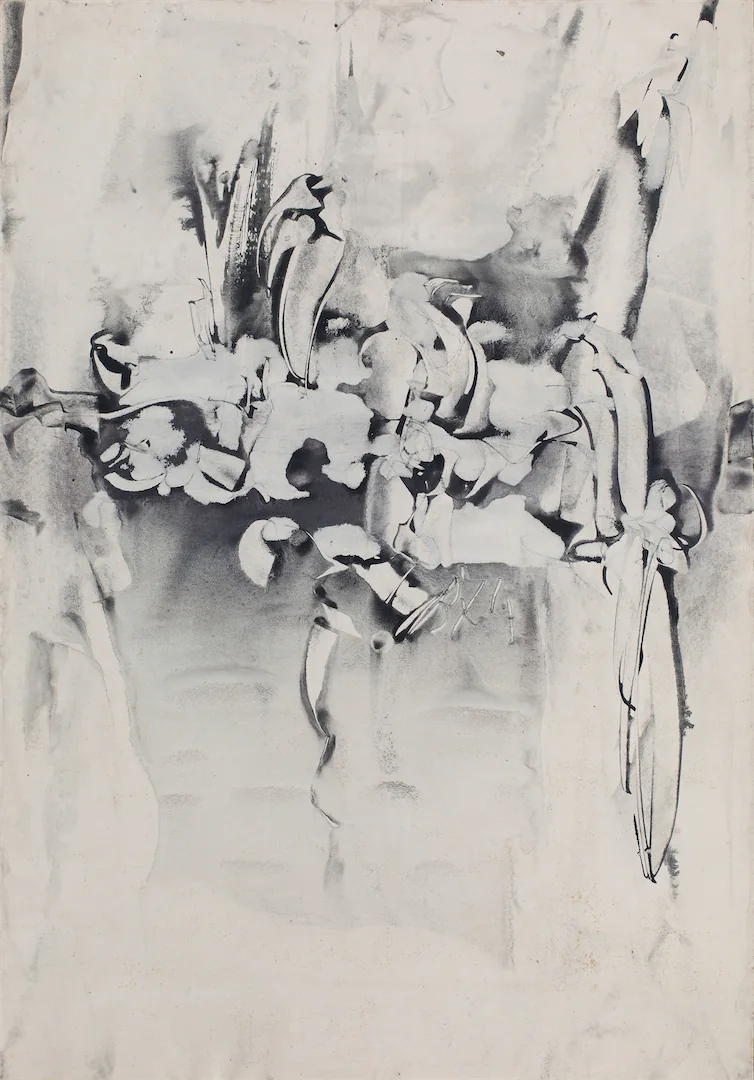
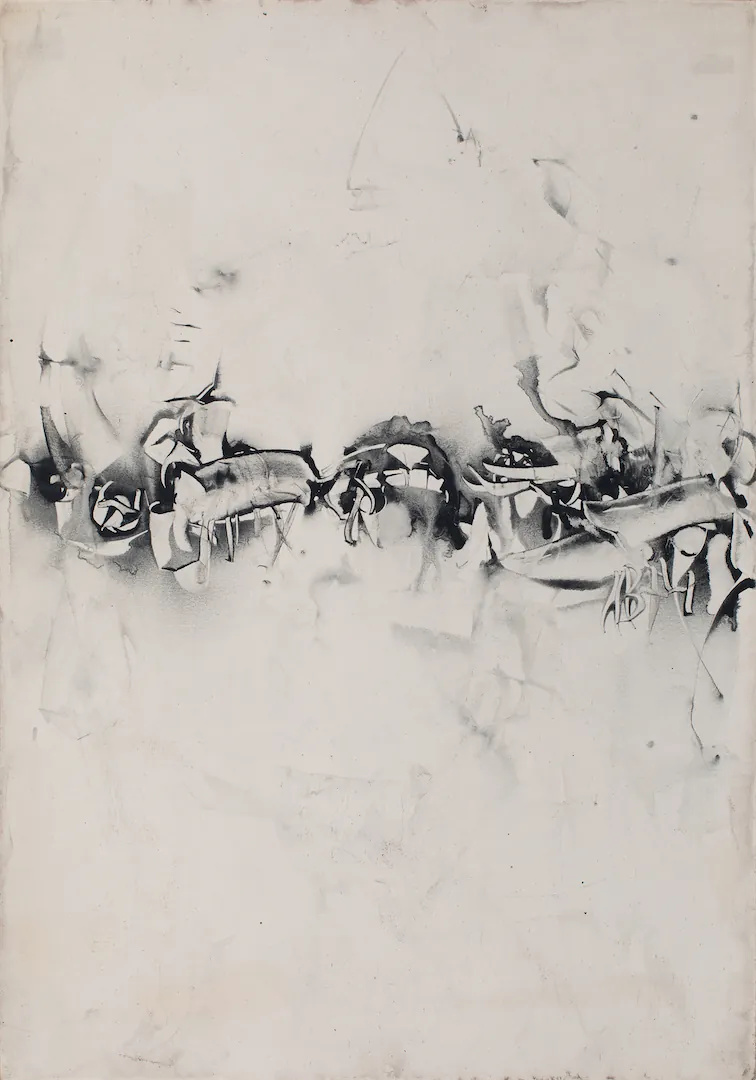
Indeed, a young student from the Leningrad Institute's Department of Scandinavian Languages, and later a student at the Theatrical College, was greatly inspired by the "action painting" of his American colleague. In 1956, Mikhnov-Voytenko became one of the first Soviet artists to work in an abstract-expressionist manner, and over the following years, made many formal discoveries in this direction.
Combining in his experience the training under the legendary theater artist N. Akimov and work at the artistic and decorative combine, as well as collaboration and communication with the most talented authors of his time (Aronzon, Knayfel, Ponizovsky), Yevgeny Mikhnov was able to create and develop a truly expressive style that, without words and images, conveys the lively and active spirit of the Thaw, the mood of the Leningrad underground, and the current issues of the European and American art visible from afar.
"Art is not a form of truth, but a form of activity. People receive a ready-made or reconcile themselves with the gestalt picture of the world—I create it myself. Insatiable people are good. The main thing in art is to excite. To excite with a new step (not a plot) of imagination." (1961)
The late 1950s to early 1960s was a time of active reflection on the essence of art and one's role in it.
In 1951, Mikhnov finally moves to Leningrad after his childhood in Kherson, evacuation to Semipalatinsk, and schooling in Minsk. This year, Yevgeny enrolls in the Scandinavian Department of Leningrad University, but derives true pleasure from attending the drama club at the DK im. Pervoy Pyatiletki.
In 1954, 22-year-old Yevgeny decides to drop foreign languages and enrolls in the directing department of the Theater Institute, where he ends up in the class of the legendary theater artist Nikolay Akimov.
Akimov's school became a unique phenomenon in the development of Leningrad art of that time, as almost all of his students later became famous and commercially successful artists worldwide: Oleg Tselkov, whose works were hanging at Carrie Bradshaw's friend's grandmother in the TV series "Sex and the City"; Marina Azizyan, colleague and friend of Federico Fellini; Levon Airapetyants, who reinvented Soviet industrial design; Eduard Kochergin, the chief artist of the Tovstonogov BDT in the 70s, and many others.
"...No one will believe you're actually strong if you don't give someone a good beating in a year or two."
They'll believe you're some kind of nobody, but they won't believe you're strong. Strength must be proven with facts.
The facts of my painting convince one or two people to some extent...
Art has been and will always remain a language, and there is nothing more intolerable in art than language itself, rather than the language of one human being for another...
I'm not thinking about the language I use with Aunt Motya, I'm talking about the language I communicate with the gods in.
The state of a bodhisattva is understanding the emptiness of the world.
Seek no other refuge than yourself. /Buddha/
We are, because we thirst for being. We suffer, because we thirst for pleasure...
Absolute knowledge means complete ignorance of things. Man is doomed to be himself, only himself and always himself.
Life strives to move in the opposite direction of the rest of the universe.
The artist is saved by insatiability — dissatisfaction increases energy.
Despite his passion for theater, Yevgeny Mikhnov turns down a job at the BDT and goes to work at the Leningrad Art and Design Industry Combine (KZHOI). He is commissioned decorative panels for canteens, Palaces of Culture, and restaurants.
There is a feeling of thawing freedom and faith in a creative and free future all around. From 1964, Yevgeny becomes a regular at the underground "Saigon" café, next to which he lives and works in a communal apartment on Rubinstein Street. He meets bright poets and artists, befriends Leonid Aronzon and Alexander Altshuler. And gradually develops his own painting theory.
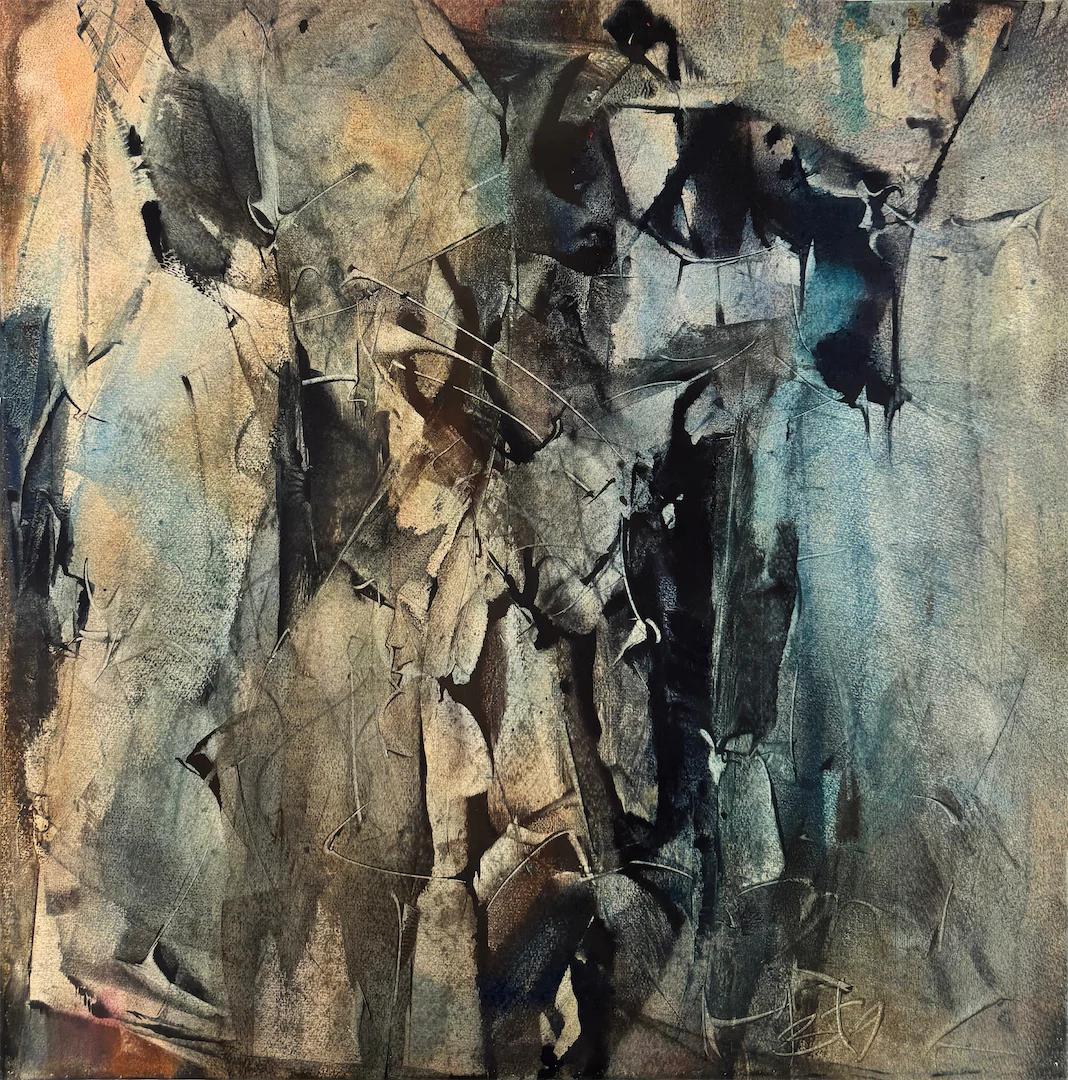
Mikhnov sought to enter into pure pictorial space, to free the world he created from relationships, from the temporal, to capture the gestalt of the simplest pictorial movement. His works are absolute formal freedom, the energy of material and color, but above all—inner freedom.
"To be an artist, it's not enough to know how to draw a similar natural form. The accepted forms must grow from within, must be an effortless offspring of the materials..."
A need for the unknown... I began to study the nature of materials, to look at paint as paint.
Strange as it may seem, this required a great deal of imagination, as each material required a different approach and each had its own possibilities, reactions, and grew lines and spots characteristic of its nature...
A fresh feeling for the material is necessary, which is the first essential condition and hope that will ultimately lead to beauty (by no means exploitation) of an organic, born form, emerging from the internal structure.
Plasticity is the result of a process, growth, reaction inherent in the structure...
Ubozhestvo — not simplicity... Simplicity is something original from itself (nature), unintentionally born. Organic.» (1968)
Since the 1970s, he has been given almost no orders for interior design. The artist remains in the lonely space of his studio, obtaining materials from acquaintances — because being without government orders, not being in the Union of Artists, practically meant losing the opportunity to acquire paints, paper, canvases.
In his notebooks there is an entry:
"Tragedy — there's no one to give it to. Art is a school of courage (one-on-one) in solitude."
Life is a scream. There is only the idea that something seems to exist.
When I'm not working or not seeing eyes that are sympathetic to me, I don't feel the difference between myself and any creature.
Should touch the fresh strings of imagination.
In a certain sense, a genius is above all else... laziness...
...not an artist — that's a meat grinder. His derivative is mince. In this world, the best thing is to sleep! sleep! just sleep... if only one could!
"Hung himself on every nail of his own house.»"
"Communication with anyone gives me almost nothing, but rather activates what has been given to me by God, but remains hidden."
Often it's a very long and painful process — to give a canvas the right to exist.
Every perceptibly small moment—a split second—gives its own material, tension, chaos, which must be ordered.
Reminding myself of the clergyman who came out of the church to jostle with the poor and destitute for alms...
Today's generation is forced to lie more frantically than the elementary bourgeois.
Law? — I bow to the exception.
An artist is an aggressor with big eyes. An experimental life.
A person is an architecture that I've never seen before and will never see again.
Look at my curtains, the folds — flaming gothic; no — inflaming gothic.»
«Return to primary contemplation.
Why people who create and distribute beauty, with the inevitability of a falling stone, are unhappy, persecuted, self-torturing, etc.
The artist thanks his own children — the works, for the fact that they came into being.
Once again: Your Highness — Loneliness.» (1967)
Throughout his many years of daily, exhausting creative work, Yevgeny Mikhnov lacked an active interlocutor who could give him the impetus to move forward and go beyond his own thoughts. The artist himself believed that solitude was harmful to him, yet the later period of his work can be described as closed and reclusive.
The only ones with whom it was truly unpleasant for him to part were his works. He often bought back paintings he had once sold.
At our Cosmoscow booth, we will present paintings from 1956-1966, as well as graphics from the period 1960-1977.
"What is genius? It's an ordinary phenomenon. The norm of human existence, the rest is deviation."
"Beauty is the only thing that justifies our existence." (1973)
Photo: Gennady Prikhodko, Elik Yafarov
© St. Petersburg, 2005, all rights reserved