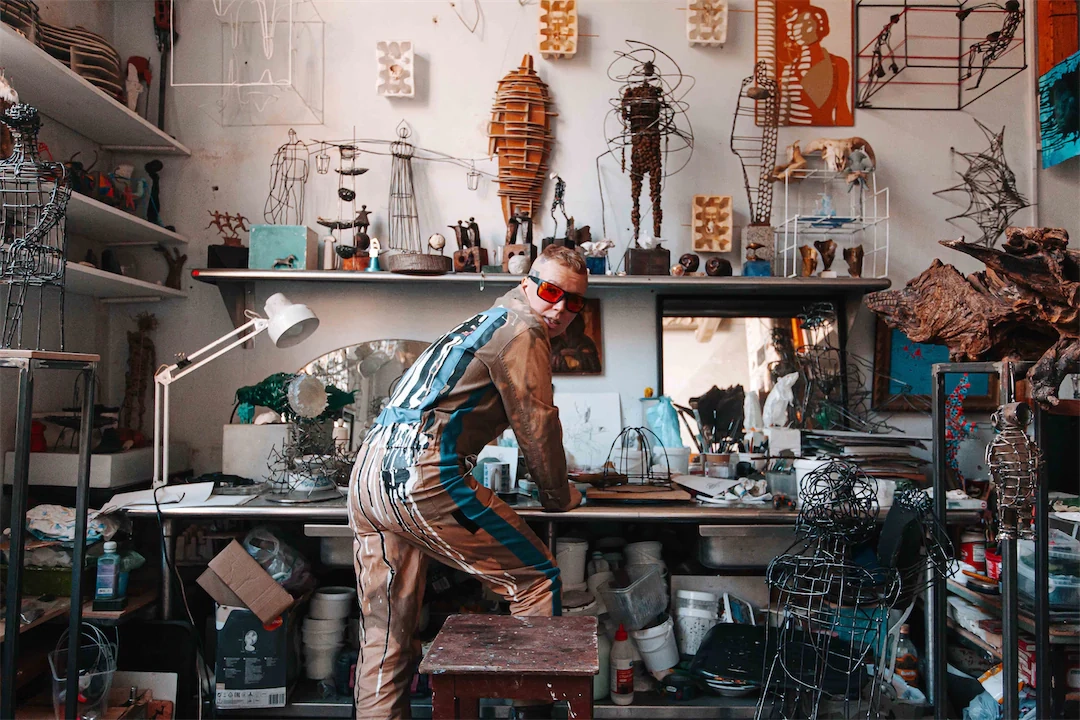
Shortly before the opening, we visited Antonina's studio in the famous Artists' House on Pesochnaya Embankment. As the name suggests, the building was constructed specifically for artists and sculptors in 1961.
The spacious, light-filled studios once hosted some of the most prominent Soviet artists: Mikhail Anikushin, book illustrator Yuri Vasnetsov, Pelageya Shuriga, and Yan Neiman.
We walked through corridors clouded with plaster dust, climbed to the second level of Antonina’s studio, and descended into the "cemetery" of plaster models to capture the calm atmosphere filled with history and creation in which this project was born.
We are sharing the resulting photographs and publishing the curator’s text for the exhibition.
Antonina Fathullina (b. 1982) is an artist and sculptor. She graduated from the Stieglitz Industrial and Technical Academy and studied welding in Finland.
Antonina began her artistic journey with ceramics, but today metal welding has become her primary medium. She works not only with iron, but also incorporates natural stone, plastic, and ceramics, exploring the expressive limits of each material.
Her street sculptures can be found not only in St. Petersburg, but also in Montenegro, the Canary Islands, Tehran, Spain, Egypt, Germany, and many other countries. Her works are held in the collections of the State Russian Museum, the Museum of Urban Sculpture, the Museum of City History, the Museum of Art of St. Petersburg of the 20th–21st Centuries, as well as in private collections.
In 1966, Australian yachtsman Peter Warner was sailing past the uninhabited island of Ata in the Pacific Ocean when he noticed smoke. He soon discovered six teenagers who had survived there for over a year after skipping school and setting off from Tonga toward New Zealand.
They lived as a commune: growing food, maintaining fire, taking turns cooking, building a chicken coop and even a badminton court. Each morning began with a song played on a homemade coconut guitar, and each night ended with a prayer.
For centuries, humanity has taught itself very different moral stories — narratives of violence, hierarchy, and inevitable evil. These stories echo through literature and culture, reinforcing fear of deviation and chaos.
Antonina Fathullina’s installation responds to these narratives through delicate, ironic wire figures of children caught in a state of uncertainty and equality. They fight, hide, draw futures on walls, and rehearse strength — suspended between catastrophe and hope.
"Life on Ata Island" is a fragile balance, a non-fictional story in which we would like to find ourselves — and decide who we want to be.
— Anzhelika Urusova
© St. Petersburg, 2005, all rights reserved