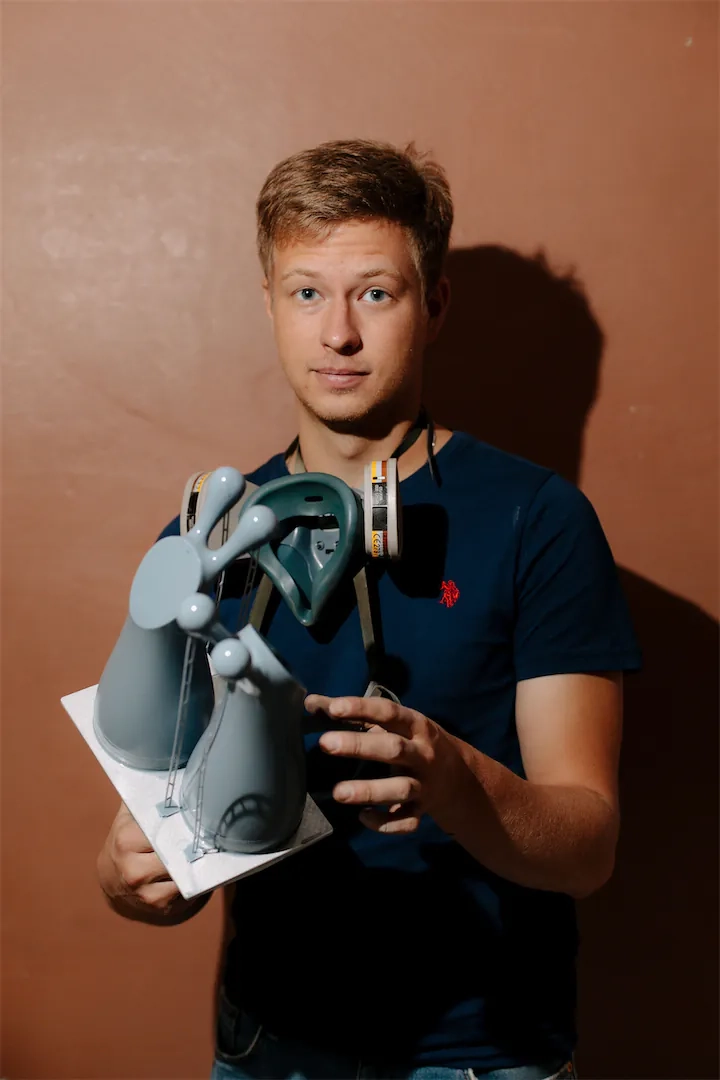
DiDi Gallery presents a selection of its young artists. The series of studio interviews concludes with a feature on sculptor Vlad Mukhanov.
Vlad graduated from the I. E. Repin Institute of Arts and studied at the Rodchenko School of Photography and Multimedia in Moscow. Vlad's primary practice is easel and monumental sculpture. His works are made from various materials, including bronze, stone, and polymers. We visited Vlad's studio and spoke with him about his new series "Observers" and "Sunbeams," which the artist presented for the first time at blazar. Read in our new feature about why the art academy graduate became interested in 3D printing, how the idea for the Newton monument came about, and what project he dreams of realizing.
From 8th to 11th grade, I studied at the Secondary Art School (SCHS) — that's the Ioganson Lyceum at the Academy of Arts on Vasilievsky Island in St. Petersburg. I completed one year externally because they had a 12-year program. Then I got into the sculpture program at the I. Repin Academy of Arts, where I received a good basic education over 6 years. I recommend it to everyone! :)
The Academy doesn't so much teach you to be an artist as it gives you good skills that (if you have your head on your shoulders) you can develop in any direction: earning money from art-related things or just from art itself. And, in principle, it gives you the opportunity to realize all your cool ideas with your own hands. When you don't know how to do anything, but you have great ideas, it's hard to implement them.
An artist is a poet, and the Academy of Arts teaches philologists to work in a specific language. If you have some thought, like a poet, you can create something with this language. The problem is that many get stuck on studying the language itself, forgetting that you need to say something with it. It's the same here, the Academy teaches you how to speak, and if you have something to say, you'll say it.
After graduating, I enrolled at the Rodchenko School in Moscow and studied there for another year, but didn't finish. Let's just say, I took a long, indefinite academic leave.
At first, of course, it will be hard to fight against this, but if that's your goal, it's possible. The year of study at Rodchenko helped me switch, there was a vibe of freedom, creativity, and a conceptual approach. It kind of adjusted my perception, but probably there aren't any specific knowledge that I took and now use in my life.
This place is more about not comprehensive learning, like at the Academy, where you come and they teach you how to make sculpture. Here they showed how to think, what approach to use. They tried to kind of rewire your brain. At the time I was studying, there were coronavirus restrictions. Most classes took place on Zoom, and it turned out there wasn't much contact with the teachers. Maybe I caught the school at not its best times, but I didn't want to continue studying because I didn't like how the educational process was structured.
The author of the project was Bratkov, and Ivan Zubarev and I acted exclusively as executors, implementing the sculpture according to his sketch. Initially, it was planned that this would be a large real granite sculpture that would be painted blue. When we started looking into it, it became clear that it would cost an insane amount of money. We were responsible for developing the volumetric sketch and cut the smile out of foam.
Our colleague Misha Savinykh welded a chaotic metal frame, which was covered with drywall sheets. After that, the form was covered with epoxy resin, and we got a pretty cool object. There wasn't the classic story where we sculpted the sculpture, shaped it, then poured epoxy resin into the mold and got the finished result. Misha was literally covering everything with colored resin as it was. I liked the project, but I can't claim it as my own because I didn't come up with it myself.
I don't like working with metal or marble. I don't really like processing them, but I like the materials themselves. Plastic is great from a working perspective. It's simple, soft, easy to work with, and malleable. I really love 3D printing, no need to sculpt and mold — that's wonderful. I've worked a bit with marble, I really like it. But it's heavy to process, and it's very hard to sell for a decent price.
Metal is easier, it's more malleable, but very dirty. It produces a lot of dust and dirt, you're all green, everyone in the workshop is covered in this dust. Metal, of course, is in principle a material that gives you the opportunity to show that you respect your viewer. Plastic is not eternal and relatively fragile. The statement in it is not as confident as in metal. If you make a work in metal, it will last at least a long time, and at most it's a gesture of confidence in what you're doing. For those who buy art, it's also important in what material the piece is made, because it's part of the sculpture, part of the statement. If these things were in plastic, I think they would work a bit differently. In metal, even a childishly made form reveals itself with a slightly more serious side.
Ivan Zubarev and I started working with a 3D printer because we needed to create some sketches for work. We began periodically printing things for orders: medals for the Alley of Admirals, for example. When we were restoring the chapel, there were some elements that were cheaper and more reliable to print than to make by hand. This topic became interesting to me, and I created my first work, if it can be called mine—I downloaded a 3D model of a naked woman that I found on the internet and printed it on a 3D printer.
I exhibited it as my small diploma project at the Academy of Arts. Everyone was blown away by how cool a diploma I had crafted. Later it turned out that it wasn't my work, but that didn't matter. People would come up and ask how I had created such a thing. I replied that I had printed it. It was somewhat provocative.
Then I wanted to create an anatomical guide for artists. To make a miniature human skeleton that could be posed, covered with muscles, and result in an anatomically correct human figure. During my studies, I encountered such a problem that when sculpting, it's difficult to capture how the pelvic bones rotate and how the ribcage moves. I started working on this guide, and it became clear that I would need to print a large number of prototypes. I realized that it would be cheaper to buy my own printer rather than order prints. In the end, I abandoned that project, but the printer remained with me. As things went on, I started printing my own creative works. And then it took off.
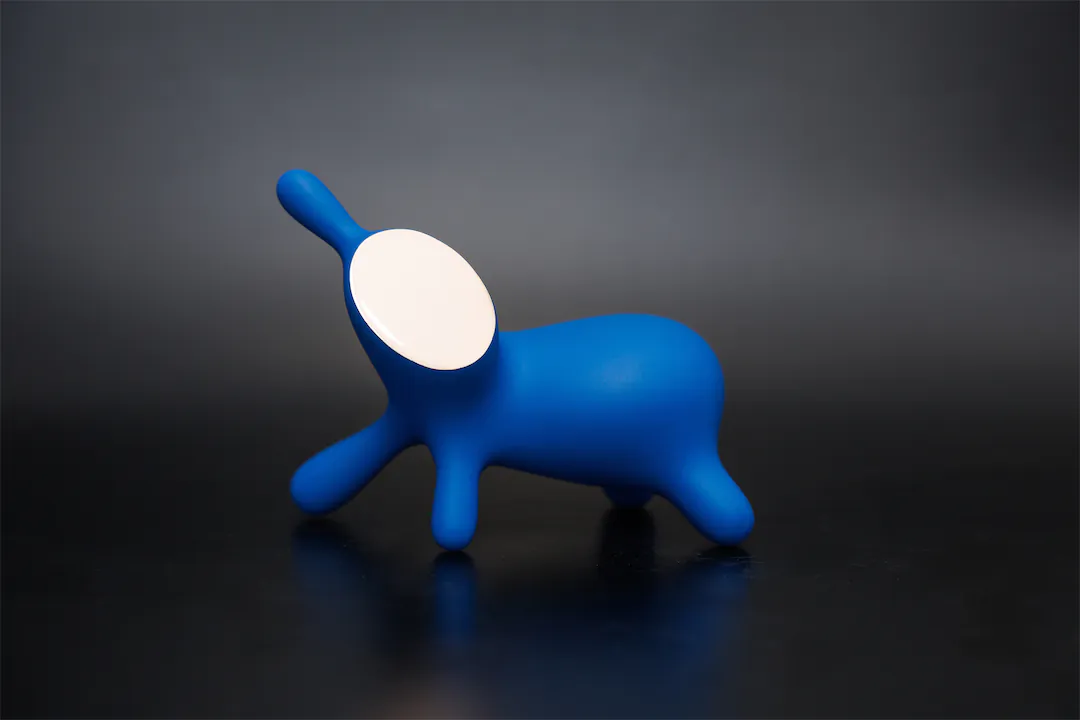
If we're talking about the form and content of the "Observers" series, they resemble some kind of organisms - living and formless beings. It's unclear where their arms and legs are, or where they're moving. They're amorphous, and at the same time, instead of faces, they have mirrored surfaces that reflect their surroundings and adopt them as their own. This creates a void that they try to fill through their environment. Empty observation.
It seems to me that this series began when the coronavirus situation appeared. People stopped analyzing and processing information through themselves. Instead, they started reflecting some position that was closer to them. They were deformed by the propaganda of one side or another. And here it's the same situation - the Observers have no top or bottom. They have no understanding, no core, it's about some kind of pliability, uncertainty. They were deformed by circumstances, they can be turned into any other pose and they will change their meaning, change their position, reflect other things. They're so cute, harmless, and cheerful, but in reality they're not about "cheerfulness."
As Bratkov said, you always need to combine the high with the low, then you get something interesting. Their form and color are something cheap, like plastic. At the same time, they're made of bronze, an expensive metal. I like that here bronze doesn't act as a material that you tremble over, as is customary in academic culture, but it performs a different function and is rather about the confidence of the gesture.
I was inspired when I was at an exhibition where an artist made simple objects like a bottle, glue, and an ear using bronze casting technique and hand-painted them. And these objects work and are perceived completely differently. The material gives different connotations.
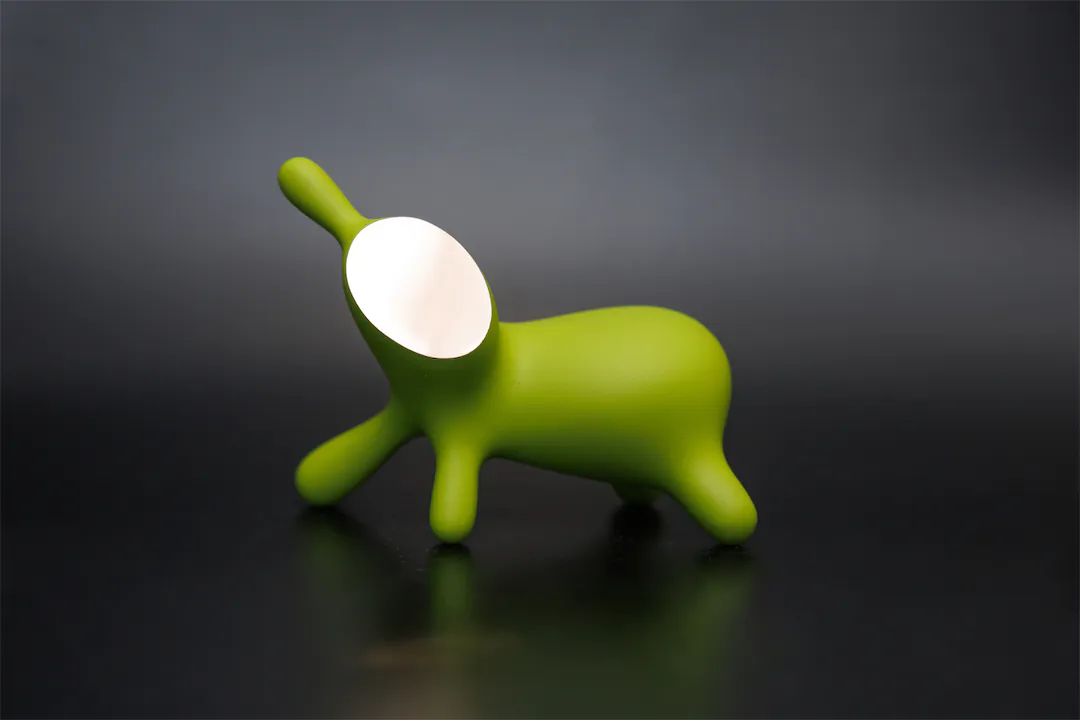
And the "Sunbeam Bunnies" turned out quite strangely. I was looking for a form, I've been interested in making a nesting doll for a long time. I made several different iterations of these objects, and this one somehow came to be. I liked it, I printed it, and when I started making it, I saw that it began to reflect light. It happened that its form also resembles a bunny. It wasn't like I conceived of a sunbeam bunny and made it.
From the very beginning, I didn't have some plan that I stuck to. I make small sketches of 3-5 centimeters from clay - I always keep it in my hands and make some forms. Then I recreate them in 3DMax, and if I like them, I print them and transfer them to material. Actually, I wanted to make the bunnies out of bronze too, but unfortunately, nesting dolls have this rule: to be a nesting doll, it must be made of a light material, while the bottom part is very heavy. You can't do that with bronze.
If we're talking about classical monuments, then these are the monuments of my teacher V. E. Gorev. They are absolutely not conceptual, but simply well-made. I admire the level of his quality. I've long understood that I don't like it when people try to make some figures unlike anything else. If we're talking about street sculpture, I like Georgy Orekhov. He has nice nesting dolls. The monument to Malevich in Malevich Park in Moscow is also a very good object.
If we're talking about foreign artists, I really like Anish Kapoor. He makes awesome things. For example, the cloud. It's simple, but with meaning. There's also Joseph Klibansky - maximally mainstream, but his approach suits me. In some sense, I imitate his story, he also uses 3D printers. He has quite quality things that he makes in bronze. They're simple, but in bronze they work in some other way.
We worked on it together with Vanya Zubarev. The developer approached us with the task of creating an interesting monument to Newton, preferably kinetic, with moving elements. We were in a kitchen in Moscow, making juice in a juicer, and we came up with the idea of creating a lifting mechanism. It is in harmony with Newton himself and the principles he formulated — the force of action is equal to the force of reaction. Several of his laws are reflected in the mechanism we invented.
In this monument, besides the mechanism, there were many interesting moments for me. We printed the figure for the master model in pieces completely on 3D printers, and it was partially made on a computer. The monument visually is very classical, everything is done in an academic style, but at the same time everything is made using modern capabilities. We used partially natural materials, partially composite materials. The elements that can be touched by hand are made of real materials: stainless steel, granite. We couldn't make the upper figure out of marble for several reasons. First, it's the cost. Second, the object needs to be lightweight on top. Thanks to the fact that the plastic figure weighs only 300 kg together with all frames and counterweights.
I'm currently working for the RBI company. We are making a kinetic art object "Mobile" for them. It consists of three stainless steel guides, at the ends of which are real natural stones. These are three swings similar to cranes, they intersect and are in balance with each other. The "Mobile" will be located inside a water fountain in a new residential complex in Repino, but it won't be installed anytime soon because the complex has just started construction.
I would like to implement our joint project with Vanya Zubarev — a monument to Peter and Fevronia. I cherish it and am looking for someone who could implement it. We took the Russian icon as a basis, the pedestal is solved in reverse perspective — which is used in all icons. The figures themselves are made of bronze rods. They resemble the incisions made on some icons — these are the brightest spots on the fabric and hands, which are made with white strokes, in old icons they are sometimes golden.
We tried to leave only these golden threads and it turns out that the faces from these thread-rods float in the air. I am a religious person and the implementation of this project will be an important event for me. From a sculptural point of view, I like that it is unusual and gives a new way to look at the icon in sculpture. Usually, when making monuments to saints, it turns out to be a compromise story. It seems like it needs to be made in bronze, it seems like it should be similar to an icon, but it turns out to be something unclear. And in our project, in my opinion, we managed to find a technique that reveals the icon in sculpture in a new way.
Of course, I would like to implement the "Observers" series in a large format and I have the work "Needle" — this is a long girl made of bronze, which I also really want to realize in a large size. I think it's a bright image and I hope that someday I will be able to pitch it to some developers :)
© St. Petersburg, 2005, all rights reserved