You create most of your works at home. Does your family participate in the process in any way?
My wife Nasya doesn't really embroider, my younger daughter Ilaria is only 2 years old, but recently I agreed with my older daughter Fanny to create a joint series – she will draw, and I will embroider based on her sketches.
She also tried to embroider, but it's a long process because you constantly need to change threads, and she doesn't know how to thread them through a needle yet.
This is also my least favorite moment in work, when the thread runs out and you need to make a knot, cut it, get a new thread, thread it, tie a new knot, and only after that continue.
Judging by your social media, it seems that you create new works every day.
Yes, that's actually the case.
Doesn't the desire to take a break or go on a short vacation arise?
Not at the moment.
My grandmother says: "I rest when I work," and I completely agree with her (laughs).
I have a main job that I do 5 days a week from 9 to 18 hours.
The work of an artist, as a rule, cannot provide a stable income — today people are ready to buy your works, and tomorrow this may not happen.
I don't want to concentrate exclusively on embroidery. Some kind of switch should happen.
For example, right now I'm learning to play the saxophone. Maybe after some time I'll stop embroidering and take up music.
Do you have a dream collaboration with any artist?
I'm interested in doing product design projects with my wife. They turn out strong precisely because of our collaborative work.
For this, it's necessary to creatively mesh with a person, and the result can be significantly cooler, which makes sense.
If we're talking about interaction with other artists, I had a positive experience collaborating with American artist Louise Caldwell for the "Art-Prospekt" festival.
We adapted to a common concept, and each of us did our part with collapsing buildings in St. Petersburg and New York. Then we stitched our halves together.
Right now I'm not thinking about new collaborative projects because I've simultaneously started two series about Hong Kong: architecture and cinema.
I need to think about a collaboration... Maybe I could do a work with some street artist.
For example, there were great graffiti artists Zoom and Pasha 183.
I also like the works of St. Petersburg artist Vladimir Abikh.
Or do something with one of the embroiderers. There's Vitaly Tyurlik, for example.
Tell me more about the new Hong Kong series.
I've made a list of 50-60 films that I want to watch or watched in my childhood.
Then I made frame templates based on which I plan to embroider.
I have a childhood memory - in the 1990s, one of our neighbors put up an antenna and somehow by some miracle cable television appeared on our TV.
And there was Leonid Volodarsky with his voice dubbing those mind-blowing Asian films, and my brother and I watched them.
Also, I have many warm memories associated with Hong Kong. We were there several times with my wife and spent our honeymoon there.
Now I want to start a series with inspiring stories and call it "Accidental or Unintentional Hero."
The idea came to me a month ago after I watched a video where in 1996 in Romania, a skinny 15-year-old boy saved a boy who fell into a pipe.
I thought that boy was a real hero, although maybe he didn't realize it at that moment.
Stories like that encourage me. In childhood, I always wanted to do something heroic, to help someone.
How the idea for the "Embroidery on a Walk in Kolomna" series came about. Do you come up with plots in advance and how do you choose locations?
The idea of street embroidery came to me a couple of years ago, but I couldn't get around to it because of other projects.
In March-April of last year, I decided I could start doing something in this direction.
I finished a big project with the Narkomfin building and had a small embroidery the size of a palm left.
I thought I could use it, went out and stuck it on a wall.
It was a nice scene with a girl and Ded Moroz (Father Frost) holding hands. That's how the series began.
Then I started adding supportive quotes and sayings to the works so that a passing person could read them and feel happy.
As a rule, ideas for embroideries come spontaneously.
I love music very much and recently I've been actively listening to Russian performers.
That's why I often use phrases from songs by the bands "SPBCH", "Arseny the Baptist" and "Nursing Home for Autists".
It takes from half an hour to two days to create small street works.
I glue the embroideries on double-sided tape and try to place them on ads like "Rest" and "We'll get rid of drug addiction".
Is there any desire to take this series to other districts or cities?
There have only been two exceptions.
The first was a shoot for NTV in a project about creative people in St. Petersburg.
We filmed here, in Kolomna, and then went to "Kamchatka", where Viktor Tsoi worked.
I have a series of works with musical groups and for the plot I placed an embroidery with a Tsoi quote on the wall.
The second exception happened for Winzavod in Moscow, where as part of the "Artmosphere" biennale I made a large work "House" and posted small embroideries on the territory.
But otherwise, everything here, Kolomna — is the best place in the world.
And what are your favorite places in Kolomna?
It's hard to say. When you love someone, you don't choose a separate part of them – just a hand or a foot.
For example, in Kolomne I like the so-called "giraffes" – the Admiralty shipyards.
When you look at the Holy Isidore Church with its domes, behind them you can see these industrial giraffe-cranes and it creates an interesting view.
I also really like Turgenev Square, which forms a cozy corner.
Tram No. 3 runs here, it has a cool route, and it goes right down the center of the street.
Right now at our group exhibition "Journey Home" you can see your large-format works - is this an enlarged version of your street series or something new?
I wouldn't call it a series. Rather, these are separate works. Maybe just an unfinished triptych (laughs).
I've recently gotten into Orthodox icons, and this is a reference to iconographic images.
My family and I traveled to the North through Arkhangelsk Oblast, Karelia, looking at wooden churches and frescoes.
I thought that through this inspiration I could create new embroideries, and you just wrote that works for the exhibition are needed as soon as possible (we laugh).
I decided we'd come back from the trip and still have two weeks, but then I looked and realized I mixed up the dates and there were only 4-5 days left until the opening.
Yes, I'm very sorry...
But I, on the contrary, love tight deadlines when you have to just get something done, because otherwise it will drag on. When there are no hard deadlines, you'll keep putting it off and putting it off.
"You're Welcome" - a reference to the Archangel Michael who stands at the gates of Paradise and decides who to let in and who not to. He stands with outstretched arms and a smile on his face.
And the second part "No Entry" - this is a resentful demonic figure with a club.
Throughout the entire journey home, one encounters many different characters: some are ready to help and share their last piece, while others won't even let you through the door.
This is also, in a way, the final stage of the journey home - one will return and be accepted, while someone might never be able to get back.
If you could right now build or restore any three buildings from the "Avant-Garde Architecture" series, which ones would be luckier?
There's so much I want to restore or bring to life. We could talk about architecture for hours.
There's a problem with the Ushakov Baths, built in the 1930s. They are now falling apart and have burned several times already.
There were some initiatives to restore them, but they just fenced off the baths, boarded up the windows, and they continue to stand - the problem wasn't fundamentally solved.
I have an idea to hold some kind of event there - for example, to embroider the bathhouse in winter on location.
You could also implement the Lenin Institute of Librarianship project, designed by Ivan Leonidov in the 1930s.
At the time, it all remained paper architecture, but today technical possibilities have emerged.
And the flying city project, designed by Georgy Krutikov in the 1930s. Although that's impossible today.
Soon our whole team is going to Moscow for the blazar and Cosmoscow fairs. What places would you recommend visiting?
The Narkomfin House - one example of how you can turn a building that was in terrible condition into something amazing.
This story had a big impact, the restoration was done by the architect Moisei Ginzburg's grandson, and the team received a bunch of awards.
If you haven't been, the GES-2 is an excellent project in terms of how you can turn a building in a sorry state into a place of attraction.
And then there's the Winzavod.
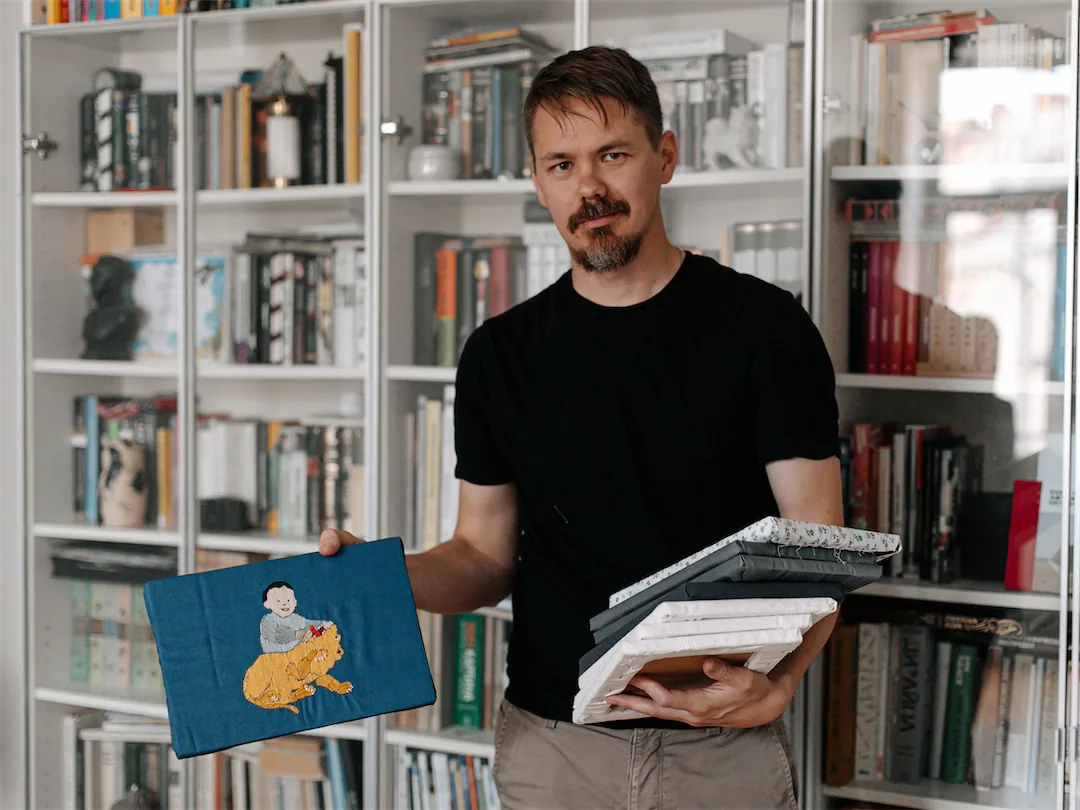
Photo: Elik Yafarov
© St. Petersburg, 2005, all rights reserved