Only a few days left until the start of the Cosmoscow fair at the Expocenter VVC.
In the meantime, we continue to tell about our artists in the format of studio interviews. Today the column will be continued by Konstantin Reshetnikov — a contemporary Petersburg sculptor who creates metal figurative sculptures in the aesthetics of minimalism. At the DiDi Gallery booth, the author will present a new series of animal sculptures Unicorn, assembled into a single composition.
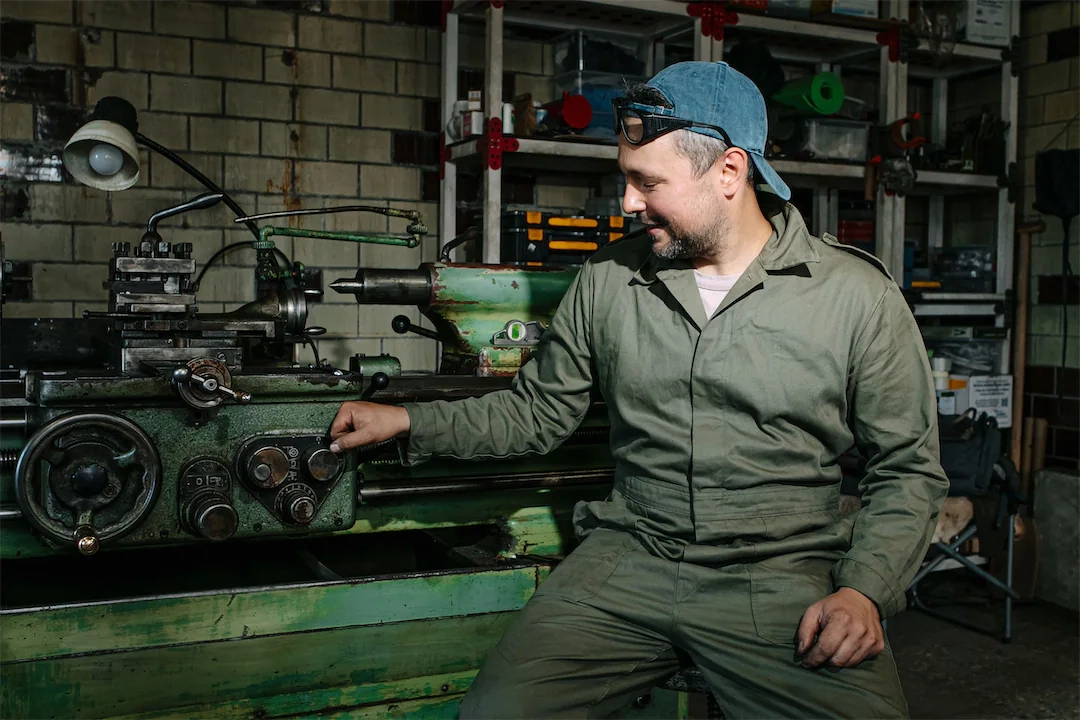
For Konstantin, the artistic process is a kind of scientific activity where the author can put forward hypotheses and conduct research based on them. We visited Konstantin's workshop on the territory of the former "Skorokhod" factory and saw with our own eyes how work is done on a 1960s lathe and how his sculptures are assembled.
Read in our new material about how Konstantin Reshetnikov found his artistic language, what is the main enemy of paint production, and how much time it takes to turn out 30 metal unicorn tails.
Tell me about your workshop. How is everything set up here, and how does the work process go?
This workshop appeared for my friend and me right after the pandemic. We moved into it from a street art museum where we used to be based. At one time, this was a specialized space - there were giant compressors that circulated air throughout the factory territory, and instead of windows there were radiator grilles.
As soon as we moved in, we scrubbed the walls with a brush because they were covered in machine oil. Then we installed the windows and gradually got everything in order. There used to be many dogs running around the territory, but they were cracked down on and a separate enclosure was built for them, where they now live. Because of this, a lot of cats have appeared, and they feel quite comfortable here. They occasionally come around.
In early August, a Czechoslovak lathe from 1964 appeared in our workshop. We found it on Avito, brought it over, and with great difficulty managed to drag it in, because it weighs about two tons. The lathe is from the high-precision category, they don't make such machines in the post-Soviet space anymore. Its body was cast from iron, and after that it had to stand in a hangar for about 10 years so that the metal would normalize and all processes would stop.
Such machines were once used in factories, but after the collapse of the USSR, many factories closed and everything started being sold off. Before this one appeared, I had to travel to different factories and make arrangements to start working. Now I'm preparing for Cosmoscow and have already made 120 legs and 30 tails for sculptures. Most of the operations are done on this lathe—it has a special conical ruler that significantly makes the work easier.
How does the process of working on a sculpture happen? How much time does it take to make one tail or leg?
I spent a total of about two days on 30 unicorn horns. They are made from a large diameter cylinder, so you need to remove a significant amount of metal. There are more serious machines that can remove a large layer of metal in one pass, but on mine, I need to make many passes.
The legs are made faster, but it still took several days for 120 pieces. To keep from going crazy, you have to alternate processes. 120 identical items aren't made all at once, you need to take care of yourself. After preparing the parts, the sculpture is assembled, welded, adjusted to size, and prepared for painting.
Next, I go to the production facility where the sculptures are treated with sand and primer, and only then covered with layers of paint and varnish. Each process has a specific time frame and stages, resulting in a durable paint finish that can withstand various loads and manipulations. The piece takes on an industrial character, and that's where its special charm lies.
Does marriage happen?
Yes, for example, when it comes to coating a sculpture with titanium nitride (which is one of the coating options I use), the person who placed the blank in the chamber might have simply missed it or forgotten to turn the part over, and then the coating would end up unevenly glossy with one side having a matte stripe. The cycle in the chamber takes several hours, so to redo everything, additional time is required.
With painting, there are also moments when sand accidentally sticks due to oversight. Or the biggest enemy of painting workshops (who would have thought) - poplar trees in July. The most terrible thing is when you take a hot piece out of the oven that's still in sticky paint, and the ubiquitous fluff sticks to it. You have to wait for everything to dry, and then send it back to the sandblaster to completely clean the sculpture and repeat the process all over again.
And do you listen to anything when you work?
I mainly listen to audiobooks or music. The last one was the book "Zemlya" by Mikhail Yelizarov. Actually, my choice of books is very varied, I often re-listen to 20th century classics - from historical ones to, for example, Limonov. I could say, out of old habit, because in my childhood in Nizhny Novgorod I was fascinated by hanging out in this environment.
How did you find your artistic language?
I can start by saying that I studied at the Stieglitz Art and Industry Academy, named after A. L. Stieglitz, in the metal processing department. This was already a hint that my works would be related to metal :)
During my third year of studies, we had an internship, and we were sent to work in an office located in a trolleybus depot. That's where I got to know the factory workers: turners, mechanics, and milling machine operators. It's a whole separate world that few people know about, because nowadays it's fashionable to work as IT specialists, managers, economists, and all sorts of office staff.
And somewhere beyond the curtains, there exists a people from the real sector of the economy who can make anything with their own hands. In this trolleybus depot, there was a rich dump of former trolleybus parts and some miscellaneous metal items, which had been sent to the scrap heap and were prepared to be taken to the metal recycling. At that moment, thoughts began to emerge that all these things had character, and they could be given a second life, other meanings found. That's when the animals began to appear.
So you use the materials you find to create your works?
Yeah, recently I spotted some gas cylinders at the dump and dragged them to my workshop. Now I need to figure out what kind of gas was in there, so that everyone doesn't die when I'm making sculptures :)
In the corner of the workshop, there's also a box with a bunch of oxygen cylinders. This is medical equipment that I somehow came across on Avito. They're expired and can't be used for their intended purpose. I also use old Soviet fire extinguishers. They were mainly used in public transport and differ from modern fire extinguishers with their thick metal and heavier weight. They're easier to insert into the machine and milled holes for ears and paws.
You mentioned the academy. What did your academic education give you, did it help you form as an artist?
It's hard to say for sure. First of all, I would say that it's a gathering of like-minded people that appears in your life. In terms of craftsmanship, it's a unique education because you learn to both come up with an object and create it entirely with your own hands.
I graduated from the Academy in 2012 and I don't know how much everything has changed there over the past few years, but I really believe that it was an important period of my creative development. Life outside the Academy is quite different, and students studying there need to be prepared for that.
What topics are you interested in today's practice?
I'm interested in quasi-scientific topics that resonate with current trends and science. Mostly I turn to the forms of animals and plants, because the form of the material itself suggests it, which was something else before, and now, for example, has taken the form of a mythical creature.
There were also series with turnips shaped like bombs, in which I decided to show manifestations of aggression in everyday things, while also making references to fairy tales and mythology. I came up with a concept about human responsibility in the face of quick decisions, when science and selection make certain moves to solve logistical and economic problems, so that vegetables would have a more proper shape and fit into packaging for convenient transportation and sale. Humanity rarely thinks about the consequences when it comes to profit. Little research is conducted in the long term, and it's unknown how this will affect us.
Are you planning any new series?
From my current plans, I want to create a series of urban easter eggs placed in different locations. There are places that really catch my eye. For example, near my workshop there was a cool wall with a round hole going deep into it. I kept walking by, looking at it, and started creating a piece for this place—a dweller of the burrow.
I was passing by recently, and suddenly they cut out a piece of that wall and installed a plastic window. I didn't make it in time. Actually, there are many places like that, so it's nothing serious. I plan to develop this topic and even got some equipment: wireless, battery-powered, so I can hang somewhere on the wall and drill.
I also have the idea of placing sculptures in the forest. Leave them as artifacts that someone might find, or not. I'd like to try making a game like the old coordinate-based ones: you set a point by latitude and longitude, and an interested person who really wants to can go on an art expedition.
I plan to continue the series with fictional animals and recreate various fantastic creatures, drawing inspiration from medieval bestiaries. One can turn to medieval psalters with a wealth of material that can be realized using gas cylinders, pipe offcuts, and industrial parts.
Right now I'm actively preparing for Cosmoscow and planning to present a complete composition with a series of miniature unicorns on the theme of contradictions, failures, errors, and trends that tend to quickly and sharply change in the opposite direction. There will be several more large works. For example, "Demon" — it's a faceless creature with emptiness inside. It can contain anything at all. The unknown.
Your job requires a lot of physical activity. How do you relax?
Sometimes you have a main activity that you devote a lot of time to, and it sweeps you up in a wave, washing away all the other things you could be doing. At the same time, you're able to switch gears periodically.
I recently went to Karelia in July and organized a road trip through the wild places. Had a really great time. I also have various parallel hobbies related to historical reenactment. I'm part of a club that focuses on 15th century history. We immerse ourselves in daily life and study the historical equipment of a particular country.
There are famous Soviet posters where a man exclaims "Hurry up Monday and back to work again!" Nowadays, when you're in a taxi, radio stations play phrases like "Hurry up Friday." It seems to me that this is slightly incorrect formation of perception of life and what you do.
With that same trolleybus depot I mentioned earlier, people started to feel a certain meaninglessness in what they're doing. This trend seems artificially imposed to me. In reality, a person working at a machine is doing very useful things. People are being fed some kind of devaluation of their labor and constant "Fridays."
Maybe he enjoys what he does. After all, there are people who get a kick out of taking a machine apart and then putting it back together. Many people work with enthusiasm and probably don't think about Friday. You don't need to think about "Fridays," you need to love what you do.
Photo: Elik Yafarov
© St. Petersburg, 2005, all rights reserved