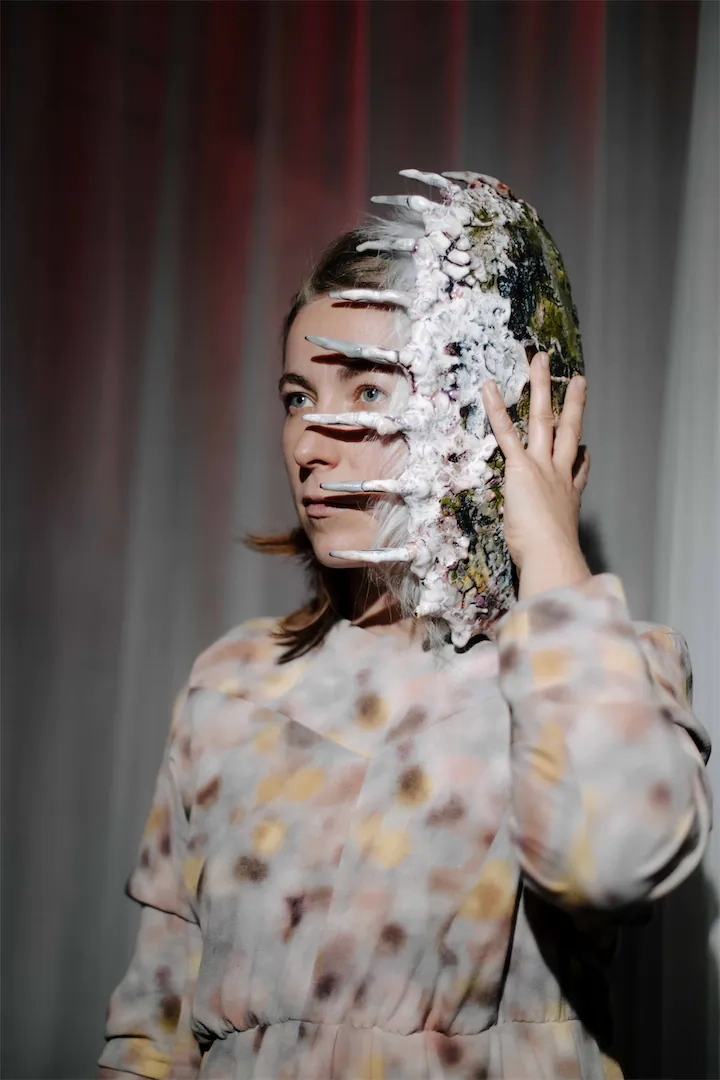
DiDi Gallery this year is participating in the young art fair blazar. From September 21 to 24 at the Moscow Museum, we will present Ekaterina Alimova, Danil Dage, and Vlad Mukhanov.
As we approach the fair season, we continue our series of interviews with the artists who will be featured at our booths. The next heroine of our series is Ekaterina Alimova—a multidisciplinary artist from Saint Petersburg who primarily works with ceramics. At the blazar fair, Ekaterina will present large and miniature objects from her "Flytraps" series.
Read in the new article from the artist's studio about how to become a mother and continue being an artist in Argentina, balancing between conceptualism and expression, and what the main strength of ceramics is.
I have a long art history. I tried painting graffiti, wrote poetry, was a member of the poetry gang "Ninado." We behaved provocatively, threw minced meat at each other, beat each other up, performed in all sorts of bars from which we were then kicked out. Later I had a musical project with a friend, and I played noise. We recorded some crazy albums with covers in the style of Roy Lichtenstein. I was hopping around the stage in a pink boa and yelling something in French. This was probably eleventh grade. Or maybe my first year... Anyway, I had a long search.
For some reason, I went into journalism. In my third year, I realized (it's strange that I only understood this by that year, but apparently, I clearly realized) that journalism doesn't exist in Russia. And, generally, what the hell was I doing there? I left spectacularly, throwing a stack of my own papers at the professor, which contained my notes. I was going down the marble steps, and all these sheets were flying after me in the stairwell. I closed the door and never returned.
Then I joined the department of anthropology and ethnography. I went on expeditions, studied the peoples of Siberia, Russians, Ukrainians, Belarusians, ornaments, and so on. I spent time in libraries, wrote academic works, and worked at the Russian Museum of Ethnography for 4,000 rubles a month, where I compiled inventories of items like a model of cod liver. And I absolutely loved ethnography and anthropology precisely from the perspective of nuances and details. The fact that each camel has a specific set of bells, each animal sounds with its own melody so that shepherds can recognize them. These are very nuanced, subtle kinds of knowledge. Very useless, but at the same time incredibly cool, they reveal the character of peoples in very interesting semi-mystical aspects. This knowledge lives with me and often seeps into my art.
I really like this imagery. On one hand, it's the everyday life of people, but on the other hand, it's filled with some kind of magic, wonder. Many of my works are built on this, although I haven't been involved in science for a long time.
At some point, I was invited to work on a church restoration. There, I earned about 20 times more per month than at the Russian Museum of Ethnography, and I realized that working with your hands isn't so bad after all. Later, I ended up in the Artists' Village, where I met a couple of famous ceramists, Shura Gladky and Vera Noskova. They invited me to their workshop, either jokingly or seriously, and for the next few years, I would walk through those streets between wooden houses to their countryside residence and learn the basics of ceramics.
It was strange because everything I had tried before really captivated me. But it would captivate me for a month or two, for half a year, and I would change the medium and the search would continue. But ceramics held me for a very long time. Apparently, when you start doing something right, to say something banal, the universe turns to you and starts pushing new opportunities to promote this direction.
Then I ended up in a workshop with guys who were graduates of the Mukha and Lviv Academy of Arts. For a couple of years, I pestered them with questions, and then I started getting commissions. First, some applied things, and then sculpture. Later, I had summer creative residencies and symposiums. At some point, they started pushing me toward a commercial direction, which now practically doesn't exist.
In our current workshop, we decided to create an artist-run space called "Artists 24." It consists of six workshops and a gallery that we use as a platform for experiments: we organize collective and solo exhibitions, and invite other artists through open calls. There is an opinion that we have a group with the same name, but in reality, it's a very ephemeral phenomenon. Just recently, we went to some exhibition with colleagues and almost in unison said: "We are Artists 24!" This was the first manifestation of such a group identity.
I was writing a manifesto. Of course, we're a long way from the Futurists or Oberiuts, but in a nutshell, our group is about unity, diversity, and the fact that together we can achieve much better results.
Yes. In your gallery, there is a work called "Journey to the Edge of Night." Quite expressive. For me, it's very iconic. It's about feelings and exploring the deeper sides of oneself, one's psyche. The idea for the work came when I was sailing on a yacht from Cadiz to Las Palmas for 10 days. I stood night watches alone, and in my free time I read Céline. It was a very emotional experience, a journey to the edge of night.
The dream, when we were on a yacht, swimming in the ocean, drinking baracitos and fishing, just like in Céline, came to some very powerful plot twist, quite dramatic and tragic.
My daughter was born in Argentina. This is connected with mobilization and an attempt to emigrate. Being far from the Motherland is in itself a traumatic experience. On the surface, it's the running around, documents, another country, another language, but giving birth to a child is also a very powerful experience, but on another level: deep-mushroom-Bowsian, mystical. I immersed myself in the Argentine context with Borges, the jungles, the roar of jaguars. The geopolitical overlaid with the personal.
Then I realized that staying there wasn't realistic, I needed to leave and come back properly. And we returned. For me, the entire trip and the birth of my daughter was a journey to the edge of my own inner night. The work I'm doing now takes this experience into account. It's been made by a much deeper and more worldly person compared to who I was before the trip.
Photo: Elik Yafarov
© St. Petersburg, 2005, all rights reserved