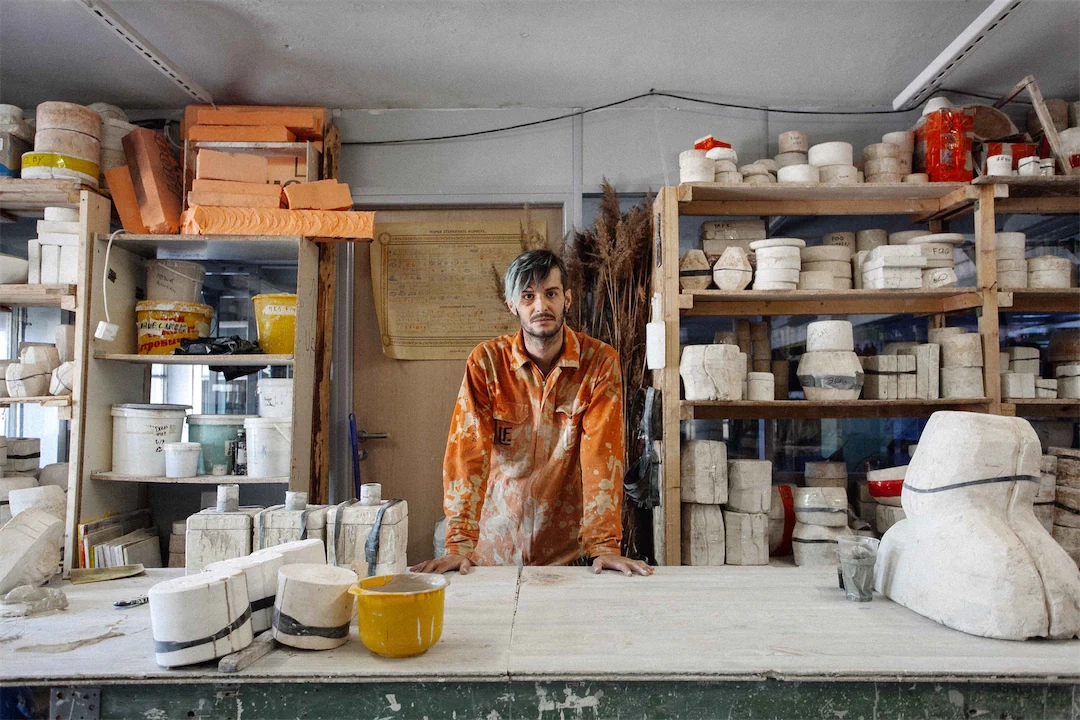
Artem Maksimov creates in a spacious studio in the "Svetoch" loft on Bolshaya Pushkarskaya Street. Self-organized exhibitions of Belarusian or St. Petersburg artists also sometimes take place there.
In our new material, we showcase the ceramic lifestyle of the artist, talk to him about the Belarusian context, about ceramics as a relevant medium, and reflect on the national in art!
Artem Maksimov (b. 1990) is a Belarusian ceramist and author of art objects, living and working in St. Petersburg. In his work, Artem develops ideas that balance on the edge of East Slavic mythology and marginal art practices. His characters become figures of street, prison, and everyday culture — couriers, gopniki (young street thugs), convicts, pigeons, or OMON (special police) officers. Using decorative techniques rooted in the genre of ceramics, such as gilding, the artist aestheticizes phenomena of low culture and places them on a par with other images of high art.
This is a very complicated question, or rather, it has a very long answer because I've tried many things. I studied at med school, I studied at a vocational school to be a bricklayer, a tile setter (they kicked me out of the vocational school after two months).
Yeah, :) Then I finished 11th grade, applied somewhere else, and then thought: "Well, where am I gonna get in." Especially since both at school and my parents told me "you won't achieve anything." They actually wanted me to become a musician, so I went to apply to a music college, but I deliberately sabotaged the dictation (ed. note — solfège). I couldn't stand music at that moment.
After that — I was walking past an art college one day and thought: "Let me just go in — I'll get in." I went in — I got in. I was 18 years old then. I enrolled and graduated from the Belarusian State Academy at 26. At that point, there was no turning back. I fell in love, realized that this was what I wanted to be, what I wanted to do.
After graduating from art school, I came straight here (ed. note — to St. Petersburg) and started pursuing art. But finding myself as an artist, understanding what I wanted to do, came later. The problem with art school is that they teach you very well how to work (the craft), how to sculpt, how to draw, how to paint, but they don't teach you how to be an artist. Moreover, they really crush your self-esteem, saying: "Look, see the classics, and who do you think you are?"
I've always participated in exhibitions, curated a lot, organized myself, but there were always many orders, and there wasn't enough time for art. Covid did its thing! Our main clients were museums, galleries (souvenirs), bars, restaurants (tableware) — all of this turned out to be closed. No work, what to do. Got boring, had to do what I wanted for a long time. It somehow went that way, and after that I didn't want to return to orders.
I fell in love! I was at an art symposium and there I met Katya (ed. note — Katya Alimova, artist), my ex-wife. And love began to blossom.
Yes. I am Belarusian in the first and last generation. Nationality is mostly a cultural code that you possess. My parents consider themselves Russian, they came from northern Russia. But I was born in Belarus, I absorbed the local cultural code. I fundamentally consider myself not a local (in St. Petersburg - ed.), I don't consider myself Russian. I'm very interested in East Slavic topics because in the north they're not so distinctly Slavic.
I probably won't return to Belarus anymore, unless the president changes there. I don't know when that will happen. But for now, even if I have heirs someday, they will be Russian again.
Yes-yes, to remember. And you can't help but return to it, because it's the most powerful cultural code. I grew up, lived in this country until I was 26 years old - that can't be erased by anything.
It's a complicated question. Generally speaking, being an artist is about reflecting, while being relevant is working with relevant media, on relevant issues, and so on. But, I think, one shouldn't strive to be a relevant artist.
I would say — no, although nowadays applied arts are generally pulling ahead: whether it's embroidery or knitting. This is, of course, also connected to the accessibility of this medium. Recently, many workshops have opened. We also had a ceramic co-working space for 40 people for those who want to unwind after work in the office.
And secondly, feminism is marching across the planet—practical things are being put forward, although it's a bit strange because they were inherently eternal all along.
Of course, every year I see more and more people using ceramics as a medium in contemporary art. But there's still a lot of mediocre work. You can tell that the person is just playing with the material for now. I find it boring to watch because I've been working with ceramics for 17 years :) But, overall, there's very little ceramics in art. Right now, I'm trying to convey that ceramics can be a medium, not just something applied.
I'm a conceptualist by nature, especially over the last three years. For each of my works, I've written three pages of concept. But concepts change because art cannot exist outside of context, just like nothing in principle can.
I made those same OMON officers even before the protests in Belarus. But with the protests, they completely changed the degree of their presence. Now, after February 24, the contexts have changed even more—we now have Newspeak altogether. Over the past two years, the situation, contexts, and along with them, the work, have changed radically three times.
It was such a period. I was very much in love with Zhang Huang back then. And he was also very down-to-earth, studying Chinese mythology. Even though he was expelled from China 10 times, nevertheless... I was fascinated by how he perceived his own ethnic group through his own prism. Basically, he does with China the same thing that I do with Belarus.
He was also a migrant in the US and suffered greatly because of it. And once a migrant, always a migrant. And you can't go back, because when you've lived in another society for some time, you can't help but become part of it.
Yes, you're never one of your own here either, because you'll never become one of your own, and there you're not one of your own either. Sometimes in Belarus they say to me: "Oh, but you've become Russian!"
No, I don't feel it.
I could list them for ages! I recently stumbled upon David Hopper's catalog and remembered that I've always loved him - been obsessed with him since I was about 18. It's such a Lynchian emptiness, a post-dawn color palette. And the oppressive suspense - so awesome!
Who else? Bruskin! I'm ashamed to admit, I only found out about him a year ago. It was an exhibition of thirty-year-olds (ed. note — "Generation of Thirty-Year-Olds in Contemporary Russian Art", Russian Museum, 2021 — held in the Marble Palace). I always walked past it without even looking at it. And then: "But these are my works!" (laughs). I start reading his biography: his concept is similar, he's interested in the same things, and he studies the same things — I like that!
© St. Petersburg, 2005, all rights reserved