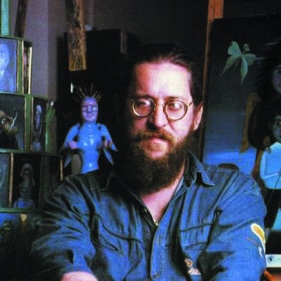
1951–1995, USSR, Naro-Fominsk
Is a Soviet and Russian artist and prose writer, representative of the art direction “ar-brut”. One of the most original and interesting authors of the Moscow art scene of the 1970-1990s.
The artist was born in a military town near Naro-Fominsk (Moscow region). In 1965 he left school and lived in odd jobs. Since 1969 he attended a studio at the Narofominsk House of Culture. Since the early 1970s, he regularly participated in semi-underground exhibitions of unofficial artists. Several times he was forcibly placed in psychiatric hospitals. Sold two works at the Sotheby's auction in 1988, and it marked the triumphant entry of Purygin into the international art market. In 1989 he emigrated to the United States, settling in New York, where he secured his success with the support of the gallery of Eduard Nakhamkin. Artist organized an exhibition of contemporary Russian "naive art" in Moscow (1992). In the same year he created a gallery, with the help of which he sought to support young authors stylistically close to him. He published three books of rhythmic prose, written in the manner of "stream of consciousness" ("Crap. Mini-Novels", 1990; "Space Fool", 1993; "Publiya", 1993). He died in Moscow from a heart attack during his next visit to Russia. In the last decade, Leonid Purygin's paintings have been included in the collections of the Tretyakov Gallery and other famous museums.
“Lenya Purygin from Nara Brilliant” — a visionary artist, creator of folding paintings, author of the chronicle of dreams and a preacher of the idea of universal love. He almost immediately went down in the history of Soviet unofficial art and got earning fame and success both in Russia and in the West. Leonid experienced a clinical death as a result of a suicide attempt at the age of 19. After that his worldview completely changed — he was born as an artist. Purygin has always sought to emphasize the supposedly unprofessional nature of his work, emphasizing his belonging to the "naive style" in art and "arbrut". But the “primitive”, as well as grammatical errors in the inscriptions on the pictures, is the conscious choice of the author.
The artist worked in different techniques and genres: traditional canvas, wooden sculpture; after moving to the USA, where he found more opportunities to work with this labor-intensive material, he started to make a small bronze sculpture. But the works that glorified Purygin, which are still associated with his name, are three-part foldings. The paintings on the tree, consisting of several movable leaves, were based on the shape of a portable iconostasis common in Russia.
Some of the inscriptions on the paintings are excerpts from the artist’s book “Crap. Mini-novels” about “100 dreams of Milekhin”, which became the basis of some paintings. Milekhin, one of the hypostasis of Purygin himself, wrote down his dreams, each of which described the deep layers of the artist’a consciousness in an allegorical form.
Purygin's works are compared with the works of Jerome Bosch and other masters of the Northern Renaissance — compositionally they are really close. They have a hierarchy in the form of a dominant central axis, around which the action unfolds, and the God-Demiurge represented as the “Lenya the Genius” with a palette and a brush in hands. And most importantly — a phantasmagoric world, covering the image with a detailed carpet of swarming creatures, now sinners, then peacefully resting in paradise, resembling the landscapes of provincial towns. Love and suffering are the two main forces that make up Purygin's cosmos.
© St. Petersburg, 2005, all rights reserved