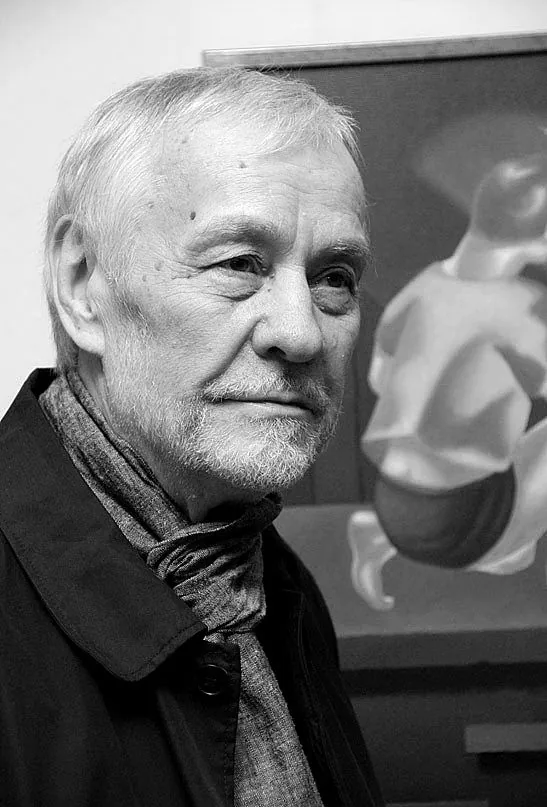
1941-2015, USSR, Perm Krai
Soviet and Russian artist, one of the organizers of the first unofficial exhibitions in the Palace of Culture named after Gaza and Nevsky.
Born on October 4, 1941 in a family of Leningraders who left for evacuation in the Perm region. In 1945, the family returned to a wooden house, located in the Leningrad suburb of Shuvalovo. As a child, mother took Vladimir and his friends to the State Hermitage especially in the Knights' Hall and in the department of primitive art.
For Ovchinnikov, pencil and paper since childhood have become the only means of reproducing impressions and observations that have sunk into the soul. According to the artist, when he had felt that with the help of drawing and painting he could “find his own language”, he seriously engaged in self-education. Then a special circle of communication began to take shape around him. In particular, his acquaintance with the artist Evgeny Semeoshenkov had a great influence on him.
Soviet ideology was alien to the artist from his youth. Therefore, he was looking for other, non-standard for his time, ways to art. He worked as an assistant painter and decorator in the Kirov Theater, and later in the household of the State Hermitage together with Mikhail Shemyakin and other young artists.
In the winter of 1971, the artist organized in his workshop on Kustarny Lane one of the first so-called apartment exhibitions in post-war Leningrad. The exhibition was attended by artists like him, working outside the official system. The result of the exhibition was acquaintance with future associates and like-minded people: Evgeny Rukhin, Oscar Rabin, Yury Zharkikh and others. However, later the artist was deprived of the workshop for misuse.
Vladimir Ovchinnikov was one of the organizers of the famous exhibitions in the Houses of Culture named after Gaza and Nevsky in 1974 and 1975. The artist participated in them with his mature painting, figurative and subject works, in which modernity was bizarrely mixed with biblical and mythological subjects.
In fact, the artist was fascinated by the theme of miracle and, as its reverse, everyday side, the absurdity in human life. In search of scenes for paintings, he willingly turns to his favorite absurd writers - Borges, Ionesco, Becket, and often comes up with stories himself. Regardless of time, from historical circumstances, his paintings are full of well-defined sketches, unexpected associations and the constant humor with which he narrated the most serious things.
© St. Petersburg, 2005, all rights reserved